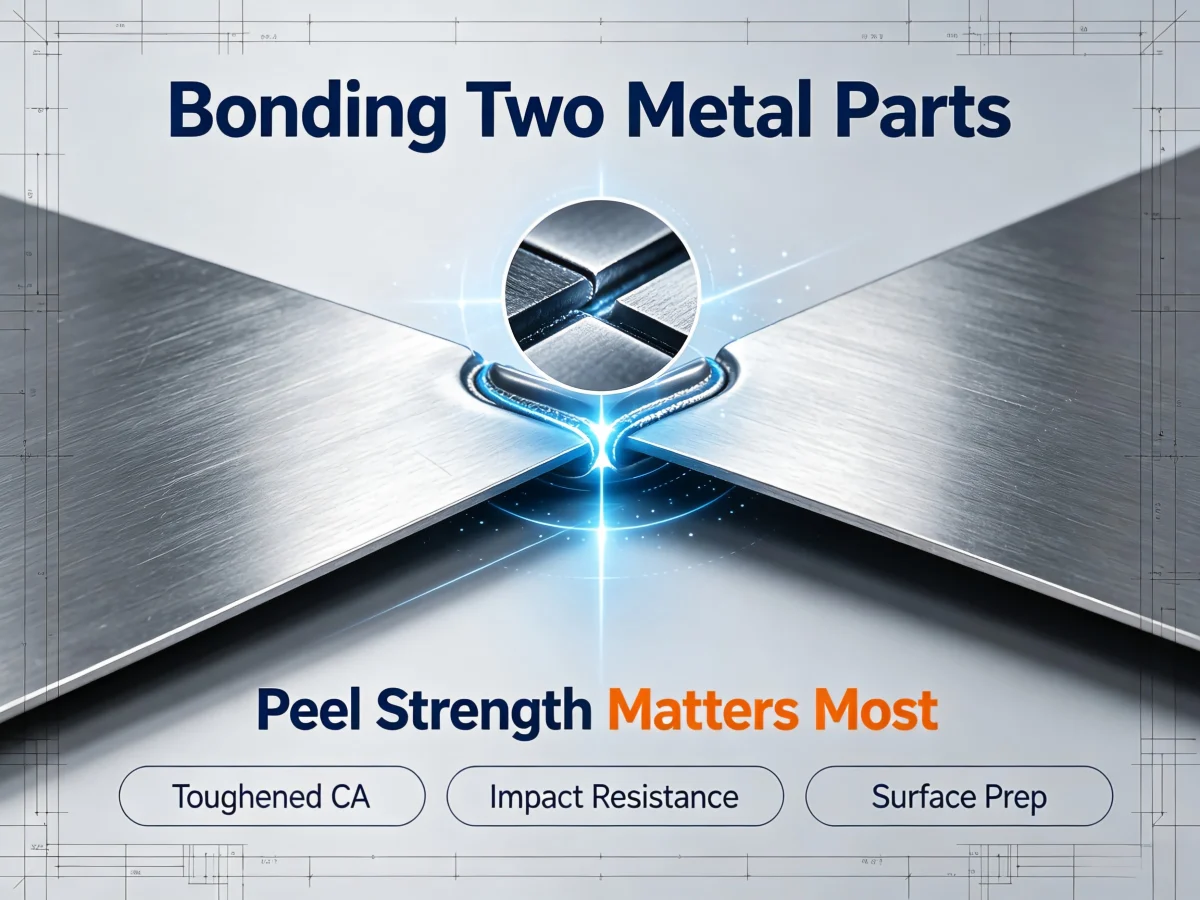
Metals feature inherent flexibility. When joining two metal substrates, the bond joint will be subjected to peel force, which is one of the most destructive stress modes for adhesive bonds. For this reason, tough and flexible adhesives are highly preferred, for the following reasons:
- Once micro‑cracks form inside a fully rigid adhesive, cracks will propagate rapidly under minor load and lead to complete joint failure. Such cracks are mostly triggered by peel stress or cleavage stress. Toughened adhesives incorporate stretch‑resistant modifiers. Instead of fracturing directly under stress, the modified matrix deforms, preventing micro‑cracks from expanding further.
- Adequate flexibility enables the adhesive to distribute localized stress more evenly across the bond line, avoiding stress concentration at single points and improving resistance to dynamic loads.
Flexibility is, however, a double‑edged sword. Excessive flexibility may allow joint displacement and shift the assembly away from its optimal mechanical position.
In practical testing, Loctite rubber‑toughened cyanoacrylate (CA adhesive) delivers excellent performance and is strongly recommended. The rubber‑toughened CA from Gorilla Glue works for light‑duty applications but is not suitable for high‑strength scenarios. Standard super glue without toughening modification cannot sustain long‑term bonding for metal components. Conventional epoxy resin tends to be brittle; bonded assemblies often separate upon impact or drop.
Depending on your metal part geometry and dimensions, prioritize adhesives with sound peel strength and impact toughness. Avoid consumer‑grade epoxy, as it tends to delaminate from metal surfaces. Silicone offers fair adhesion and impact resistance yet suffers from low overall bond strength. Toughened cyanoacrylate (CA) is a versatile option for metal bonding. Loctite toughened CA gel yields satisfying real‑world results, while Gorilla Glue toughened CA gel falls short in both bond strength and toughness.
Important Note: Surface Preparation Surface preparation is critical to bonding performance:
- Fully degrease surfaces with isopropyl alcohol or acetone
- Abrade bonding areas to create surface roughness
- Wipe off dust and residues with solvent again after abrasion
- Always run a preliminary test on metal coupons of identical material before formal assembly to validate bonding results